Introduction
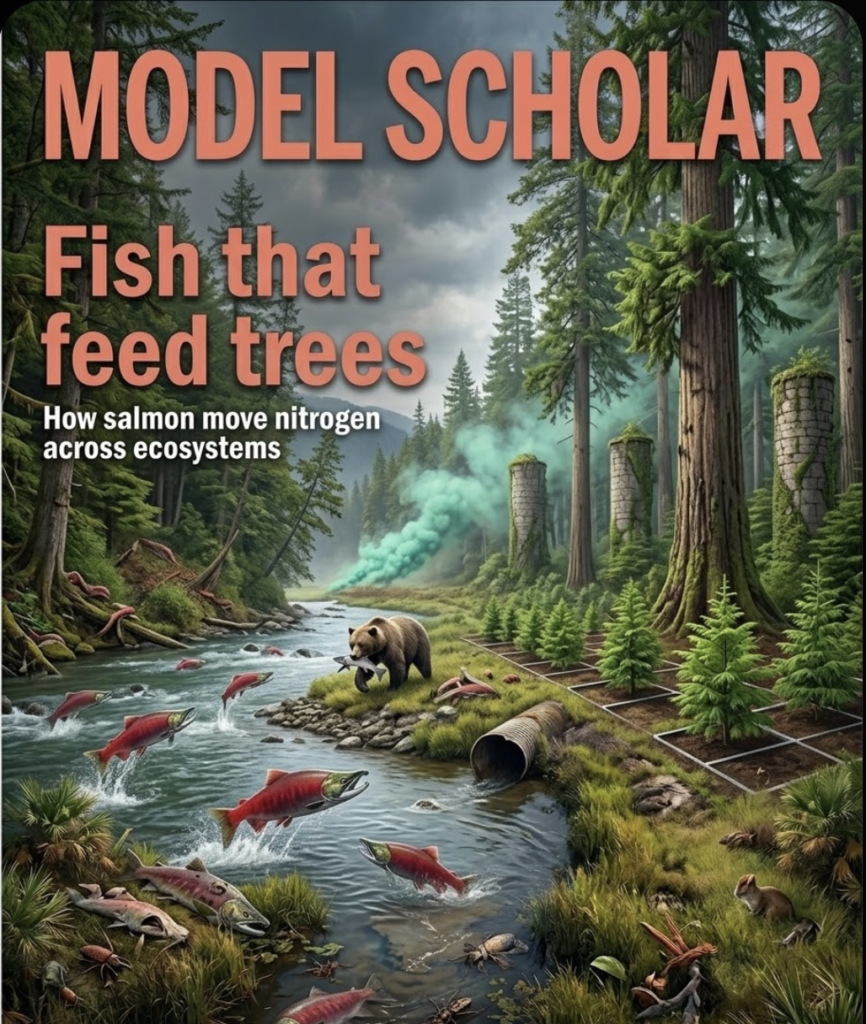
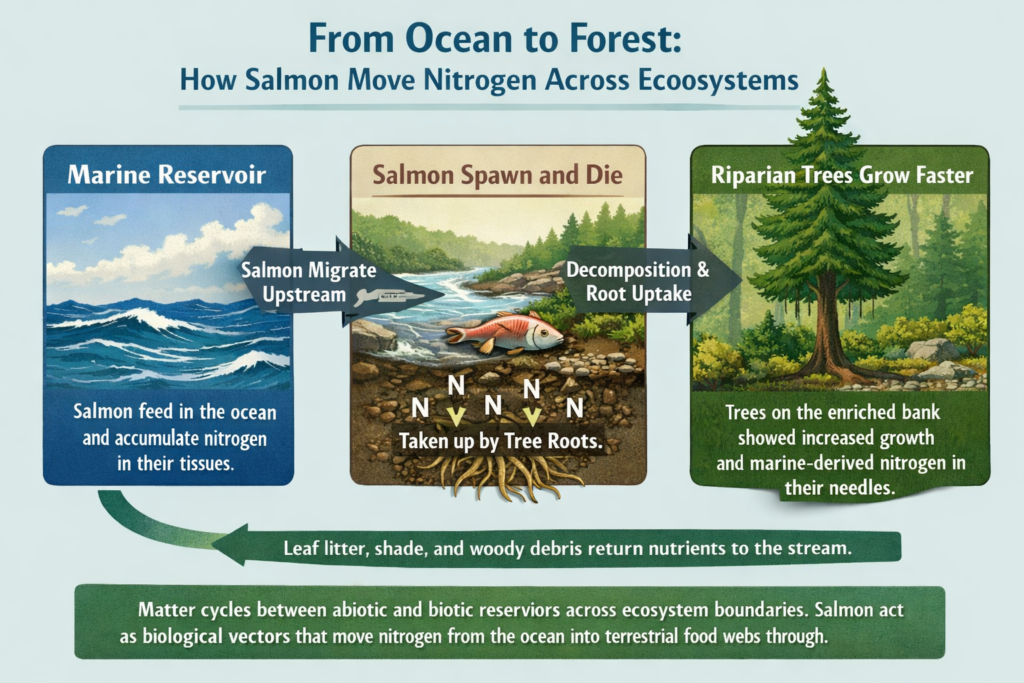
When salmon return from the ocean to freshwater streams to spawn, they carry nutrients that originally came from the marine environment. After spawning, the salmon die, and their bodies decompose along stream banks. Scientists have long suspected that these marine-derived nutrients help fertilize the plants growing near the stream. In this study, researchers tested whether deliberately placing salmon carcasses along one side of a stream for over two decades would increase tree growth compared to the opposite bank.
Conceptual Infographic
Methods
Researchers conducted a 20-year field experiment at Hansen Creek in southwestern Alaska. Each year during the spawning season, they walked the creek daily, counting live sockeye salmon and collecting dead ones. They systematically deposited all salmon carcasses on the left bank of a 2-kilometer stream section, totaling 217,055 individual fish and nearly 600,000 pounds of biomass over the study period. The opposite bank served as a control with reduced carcass input. In 2016, they sampled 84 white spruce trees on both banks. They analyzed spruce needles for nitrogen content and stable nitrogen isotope ratios to detect marine-derived nitrogen. They also extracted tree cores to measure annual growth ring widths across both a 20-year pre-treatment period (1977 to 1996) and the 20-year treatment period (1997 to 2016).
Results
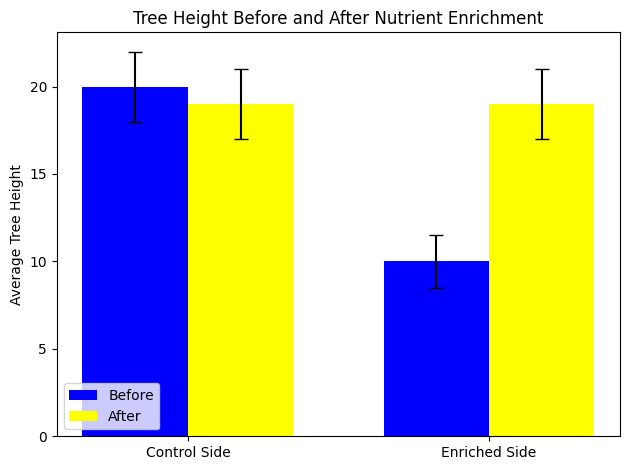
Trees on the side receiving salmon carcasses had significantly higher concentrations of marine-derived nitrogen in their needles, confirmed by elevated stable nitrogen isotope ratios. Before the experiment began, trees on the carcass-receiving bank were shorter and growing more slowly than those on the control bank. During the treatment period, growth rates on the enriched side increased while the control side did not show the same change. The difference in growth between the two banks narrowed substantially, indicating that the salmon-derived nutrients helped the slower-growing trees catch up.
Data Visualization
Discussion
This experiment provides direct evidence that salmon carcasses act as a fertilizer for riparian trees. The marine-derived nitrogen released by decomposing fish enters the soil, is absorbed by tree roots, and becomes incorporated into new growth. This finding supports a broader ecological concept: nutrients can move across ecosystem boundaries and link distant food webs. Over time, larger trees along streams could fall into the water as woody debris, shade the stream to keep temperatures cool, and drop leaf litter that feeds aquatic invertebrates. In this way, the nutrients salmon carry from the ocean may ultimately cycle back to benefit future salmon populations.
Key Vocabulary and Definitions
Riparian zone: The area of vegetation along the banks of a stream or river that is influenced by the presence of water.
Stable isotope analysis: A technique that measures the ratio of heavier to lighter forms of an element to trace nutrient sources through food webs and ecosystems.
Biogeochemical cycle: The movement and recycling of chemical elements such as nitrogen, carbon, and phosphorus between living organisms and the physical environment.
Anadromous: Describes fish species, such as salmon, that migrate from the ocean into freshwater to reproduce.
Curriculum Connections
Learning Objectives
- 8.2.B Describe the role of energy transfer in an ecosystem.
- 8.5.B
- 8.6.A Describe the role of the carbon cycle in ecosystems.
Essential Knowledge
- 8.2.B.2 Energy is transferred through food webs in ecosystems.
- 8.2.B.3
- 8.2.B.6
- 8.5.B.2
- 8.6.A.2