Introduction
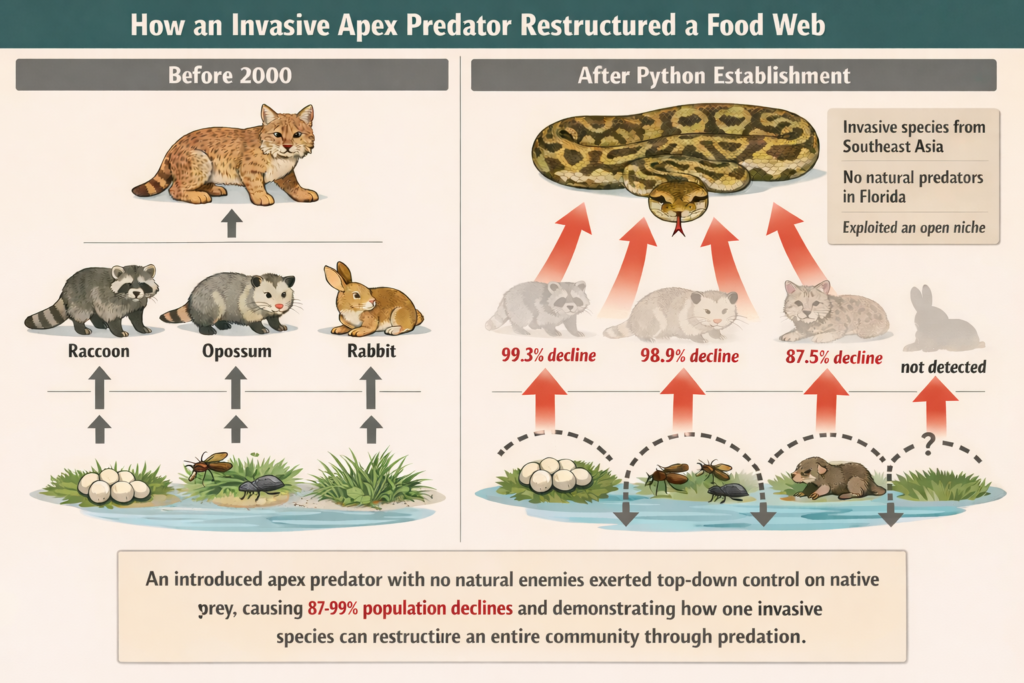
Burmese pythons are giant constricting snakes native to Southeast Asia that became established in southern Florida after being released or escaping from the pet trade. Since 2000, their numbers and geographic range in Everglades National Park have increased dramatically. Because these pythons consume a wide variety of mammals and birds, researchers wanted to determine whether their spread was connected to changes in native mammal populations.
Conceptual Infographic
Methods
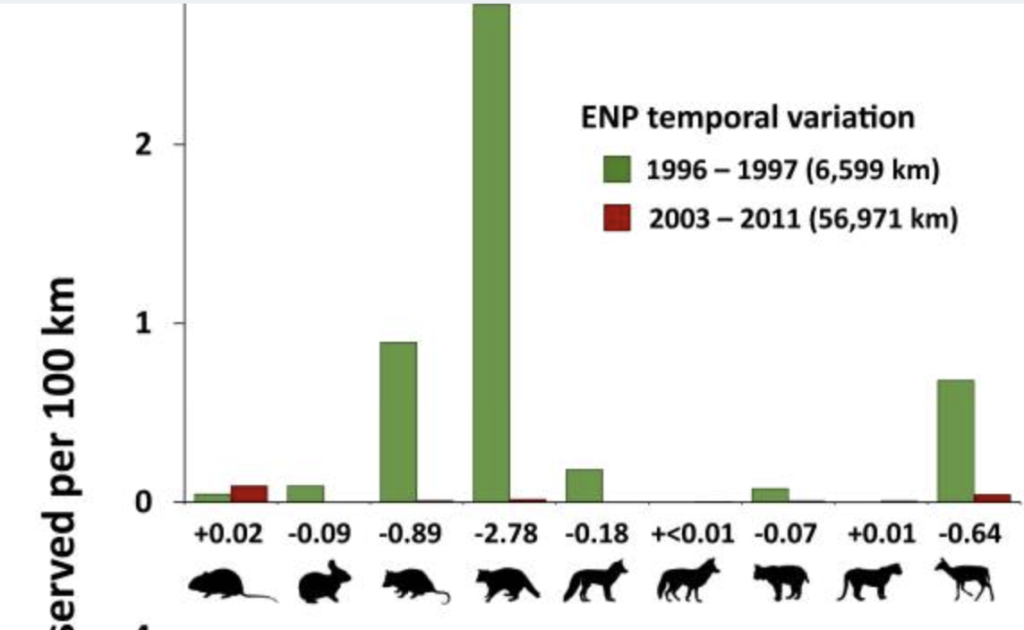
Researchers conducted nocturnal road surveys along roads in Everglades National Park, counting mammals spotted from vehicles at night. They compared observations from the 1990s, before the python population had grown large, to surveys conducted between 2003 and 2011, after pythons had become widespread. The later surveys covered a total of 56,971 kilometers of road. The team also compared mammal sighting rates across three zones: areas where pythons had been established the longest, areas where they had arrived more recently, and areas outside the python's introduced range.
Results
Mammal populations showed dramatic declines in areas where pythons were well established. Raccoon observations dropped by 99.3 percent, opossum observations declined by 98.9 percent, and bobcat observations fell by 87.5 percent. Rabbits were not detected at all during the later survey period. The geographic pattern was striking: mammals were more common in areas where pythons had arrived recently, and most abundant in regions where pythons had not yet spread. This spatial gradient matched the timeline of python colonization.
Data Visualization
Discussion
The data strongly suggests that python predation drove the observed mammal declines. The pythons function as an introduced apex predator, exerting top-down pressure on prey populations that had no evolutionary history with large constricting snakes. The near-total disappearance of once-common species like raccoons raises concern for rarer species that are harder to monitor. The study illustrates how a single invasive predator can restructure an entire mammal community within a relatively short time period.
Key Vocabulary and Definitions
Apex predator: A predator at the top of a food chain that is not regularly preyed upon by other species.
Top-down control: Regulation of lower trophic levels by predators, where predator abundance determines prey population size.
Nocturnal road survey: A standardized method for estimating wildlife abundance by counting animals observed along a set route at night.
Trophic cascade: An indirect ecological effect in which a predator suppresses its prey, which in turn releases pressure on the next lower trophic level.
Curriculum Connections
Learning Objectives
- 8.5.B
- 8.6.B
- 8.7.B Describe the role of biodiversity in maintaining ecosystem stability.
Essential Knowledge
- 8.5.B.1
- 8.5.B.3
- 8.6.B.1
- 8.7.B.1